



Subscribe to CINEPUB Youtube
Script: Mircea Mureșan, Petre Sălcudeanu, Liviu Rebreanu (roman)
Producer: Nicolae Codrescu
Image: Nicu Stan
Editing: Eugenia Gorovei
Sound: Anușavan Salamanian
Music: Tiberiu Olah
Cast: Ilarion Ciobanu, Nicolae Secăreanu, Emil Botta, Ion Besoiu, Constantin Codrescu, Ana Felicia Chiriță, George Aurelian, Gheorghe Trestian, Val Săndulescu, Sandu Sticlaru, Ernest Maftei, Colea Răutu, Ștefan Mihăilescu-Brăila, Amza Pellea, Marga Anghelescu, Cristina Tacoi, Gheorghe Cozorici, Constantin Lungeanu
Plot summary
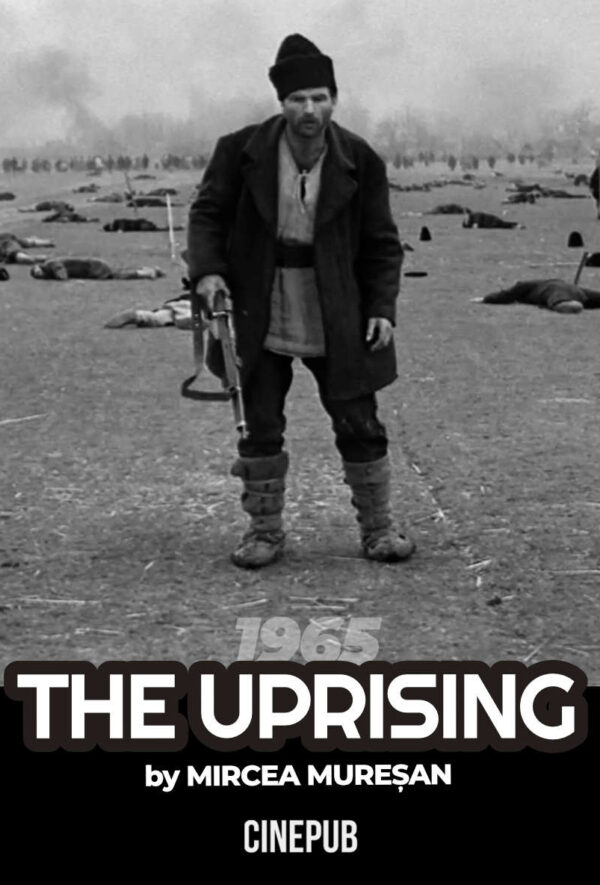
Through the character of Petre Petre (Ilarion Ciobanu), a peasant and the main hero of Liviu Rebreanu’s famous novel, the events of the 1907 uprising are recounted, from its outbreak to its suppression.
AWARDS
- “Opera prima” award for debut
1966 – Cannes Film Festival
- Award for Best Director
1966 – Mamaia National Film Festival
- Award for Best Music
1966 – Mamaia National Film Festival
- Award for Best Actor (Ilarion Ciobanu)
1966 – Mamaia National Film Festival
DIRECTOR STATEMENT
“Ilarion Ciobanu embodies Petre, mature and serious, completely in control of himself, with a steady gaze and measured movements, as if he were molded from clay and stone.”
CRITICAL REVIEWS:
“Grigore arrives at his father’s mansion in Amara, accompanied by the liberal lawyer Baloleanu, in a climate of turmoil, violence, and barely contained anger. While Christmas is being celebrated at the mansion, the peasants demand land. The landowner responds with a gun, and the crowd kills him on the spot and sets fire to the mansion. Baloleanu personally leads the repression, forgetting his liberalism.”
“I see the naked body of Nadina, played by Adriana Bogdan, running across a field in the rape scene, superbly filmed by cameraman Nicu Stan. Her breasts were visible, and she was then filmed from behind, a splendid body, an amphora-like silhouette. It was a very daring image, I think it was the first and last of such boldness.”
“The film largely follows the narrative thread of the novel, without covering all its ramifications or fully exploring its depths, sometimes resorting to simplistic symbolism, such as moving the scene of Nadina’s (Adriana Nicolescu) rape by Petre Petre (Ilarion Ciobanu) from the bedroom of the mansion to the field, illustrating the peasant’s desire, his unbridled passion for the land, identifiable with the possession of a woman — which denotes a certain uncertainty in the treatment of the vast epic material, hesitations that are not foreign to screenwriter Petre Sălcudeanu, who is also at the beginning of his career.”
“Rebeanu’s novel does not emerge from this adaptation for the big screen. It was a relatively prosperous period, when the Ceaușescu period had not yet entered into a state of panic. Perhaps this is why the spirit of the prose is not altered by ideology, apart from the natural, so to speak, implicit ideology of the literary text. The film adaptation thus remains faithful to the disturbing Romanian novel […] the director has managed to bring to the screen the equidistant tone derived from Rebreanu’s work.
“While perhaps less symptomatic of its director than “Eruption” is for Liviu Ciulei (which I wrote about here), “The Uprising” still bears the marks of an engaged filmmaker who leaves his imprint in various ways on the film. That this author would later distance himself more and more from his own productions, letting trivial action overtake the screen, is another story altogether.”
CINEPUB'S REVIEW
IF YOU WANT TO FIND MORE DETAILS ABOUT THIS MOVIE
LOGIN HERE
CINEPUB UNIVERSAL
This premiere is part of a national archive project supported by the Romanian National Film Center.
Special thanks goes to the Romanian Filmmakers Union and to the Romanian Film Archive.
Your feedback has been sent.
Thank you! We have received your feeedback and we'll try to repair it as soon as possible.
We faced problems while connecting to the server or receiving data from the server. Please wait for a few seconds and try again.
If the problem persists, then check your internet connectivity. If all other sites open fine, then please contact the administrator of this website with the following information.
TextStatus: undefined
HTTP Error: undefined
Some error has occured.
- Release Date17/03/1966
- Runtime1 hour 33 minutes


