



Subscribe to CINEPUB Youtube
Movie director
Script: Titus Popovici
Producer: Artur Brauner
Image: Nicu Stan
Edited by: Dragoș Witkowski
Sound: Anușavam Salamanian
Music: Theodor Grigoriu
Cast: Richard Johnson, Antonella Lualdi, Ilarion Ciobanu, Ștefan Ciubotărașu, Amedeo Nazzari, Amza Pellea, Emil Botta, Franco Interlenghi, Gheorghe Dinică, Florin Piersic, Sidonia Manolache, Maria Cupcea, Ovidiu Iuliu Moldovan, Alexandrina Pascu, Ina Otilia Ghiulea, Nicolae Sireteanu, Nicolae Radu
Plot Summary
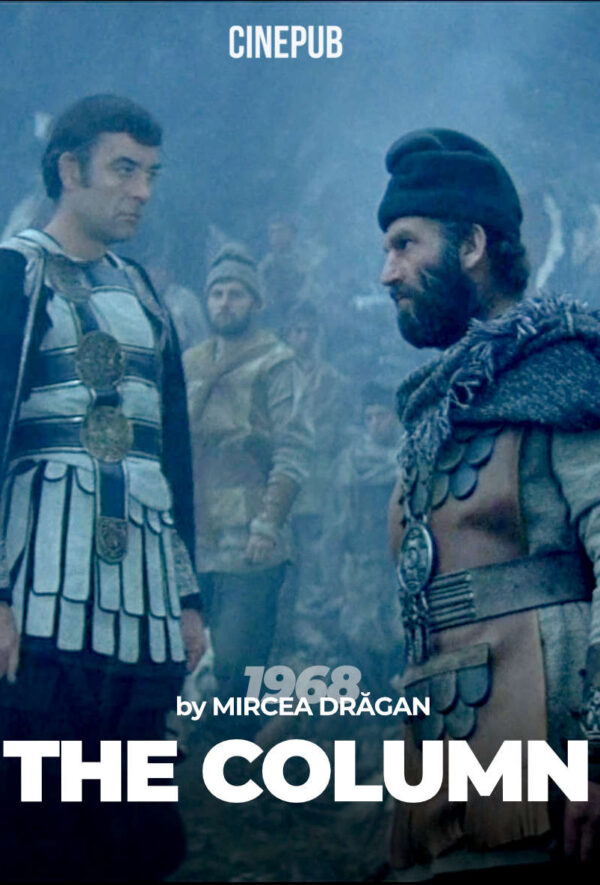
The years 106–114: Emperor Trajan lays siege to Sarmizegetusa. Once inside the conquered fortress, the Romans find no one left alive. Betrayed by Bastus, Decebalus, the Dacian king, commits suicide. Trajan devises a vast plan for the colonization of Dacia.
AWARDS
- Certificate of Merit
1969 – Adelaide International Film Festival, Australia
CRITICAL REVIEW
“Inspired by ‘the first film carved in stone about the conquest of Dacia,’ Titus Popovici’s screenplay focuses on the construction of a Roman municipium, on the reconciliation between victors and vanquished, and on the suggestion of a people’s genesis. A dramatic material far beyond the director’s capabilities was scattered in a blind melee. Paradoxically, as in The Șoimărești Clan, the pace drags precisely in the confused battle scenes.”
“The two historical figures who appear only at the beginning of the film set the tone, their actions marking the evolution of the relationship between the two peoples. Decebalus is portrayed as a primus inter pares, a reflection of the early period of the Ceaușescu regime, when the cult of personality had not yet begun—one that, in cinema, would later impose authoritarian leader characters whose orders were not to be questioned.”
“Monumental, in the Romanian sense, is above all a certain internalized feeling of time, of nature, of the cosmos. This is also the suggestion contained in some of the best sequences of The Column. The death of Decebalus is placed by Titus Popovici and Mircea Drăgan on a mountain peak. From there, in his final moment, the hero has a cosmic vision of his land, conveyed succinctly through a calm, even panoramic shot — an intense gaze that, from the height of the hero’s deeds and strength, scans the future of this land through the red veil of blood that is time. On the horizon lies the glimmer of a setting sun, although, in an image less illustrative yet akin to those sublime, inverted metaphors of Romanian folklore (“At my wedding / A star fell”), the sun could just as well have been rising. A solemn metronome seems to measure, in the film’s musical score, the moments of this pivotal scene, and here the director truly reveals a vocation for dense and vibrant gravity. A rare consonance of suggestion and rhythm ties together the slow, mythic ritual gestures with which Decebalus offers himself to death, and Tiberius severs his head; the heavy gazes Gerula casts, as if from great distances, toward the Roman; the circular movements of the camera, like those of a shaken witness.”
“Through the distinctions it introduces within its own structure, the ending of The Column is yet another argument for a higher calling of our historical cinema.”
“The creators of the film The Column have chosen, from the history of our people, the most difficult episode: that of genesis. How was proud independence converted into equally proud Roman consciousness? How did the stern Roman soldier transform into a constructive citizen of the province of Dacia? How did the relentless enemies of yesterday come to understand one another—how did they, together, raise marble temples upon the smoldering ruins of Zamolxis’s sanctuaries? By what miracle did hatred turn into love and the sword into a plow? What law of history laid the strategic foundations of the Roman limes in the Carpathians, the hearth of the Romanian people?”
“The Column was conceived in human terms—first as a living historical drama, and only afterward as a monument. Since it’s not about national heroes (Decebal does something noble and dies in the first 10 minutes), the screenwriter, Titus Popovici, was able to portray his characters on a normal scale.”
“Another pleasure here is seeing Romanian cinema aligned with the 1960s practice of international casting. And so what if Richard Johnson was a Richard for those who couldn’t afford Burton, and Antonella Lualdi had no reason to cause Sophia Loren any professional anxiety? What matters is that he is good, and she’s not bad either. Gheorghe Dinică is superb in the role of the traitor Bastos, and his mea culpa (“In my wretchedness, like a rabid dog…”) rightfully became part of folklore.”
“The mythical dimension of the plot is well highlighted in sequences such as the trial of the ‘lords,’ in which even Zamolxis himself could have taken part. The scene where Decebal bids farewell to the land of his country is memorable, as is the one seen through Tiberius’s subjective, alcohol-blurred perspective, as he parties with ‘Ciungu’ (the moment with the two revelers is the most humorous, and the improbable buddy movie element significantly increases the film’s appeal).”
CINEPUB'S REVIEW
IF YOU WANT TO KNOW EVEN MORE DETAILS ABOUT THIS MOVIE
LOGIN HERE
CINEPUB UNIVERSAL
This premiere is part of a national archive project supported by the Romanian National Film Centre. Special thanks goes to the Romanian Filmmakers Union and to the Romanian Film Archive.
Your feedback has been sent.
Thank you! We have received your feeedback and we'll try to repair it as soon as possible.
We faced problems while connecting to the server or receiving data from the server. Please wait for a few seconds and try again.
If the problem persists, then check your internet connectivity. If all other sites open fine, then please contact the administrator of this website with the following information.
TextStatus: undefined
HTTP Error: undefined
Some error has occured.
- Release Date18/11/1968
- Runtime2 hours 15 minutes


